Re-Learning How to Run By Elliot Williams As I write this, four astronauts are on their way around the moon for the first time in 50 years. A lot us have asked ourselves just exactly why you'd send people out that far when the environment is so hostile and we have increasingly competent robots that could do the jobs in their place. If anything, that's even more true now than it was back in the day of the Apollo program, when the remote operations capability was a lot more constrained. But having people, potentially in the near future, on the lunar surface remains qualitatively different. 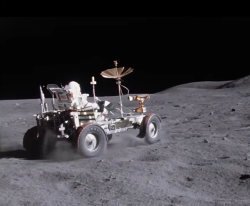 I was recently re-watching some of the footage from Apollo 16 when the astronauts were driving around in the Lunar Roving Vehicle, and the discussions that they're having about the lunar geology that they can see for the first time with their own eyes is very convincing. Having people in situ tightens the loop of "hey, that's interesting", "let's take a closer look", and "I wonder what that means" in a way that minutes or hours of transmission time, and sterile observation of photos on a computer monitor just break. In comparison, our Mars rovers move excruciatingly slowly, the data comes back through a very thin pipe, and it takes months or years to analyze. Of course, there is danger to human life; it's a lot more expensive to get people safely to, and importantly back from, the moon than it would be with a disposable robot. Comparison with the Mars rovers is also unfair because travel to Mars is another scale entirely. Even if it does make sense to send humans for exploration on the moon, it may not make sense to do the same on the red planet, in the near future or ever. Given all that, I'm stoked that we can see through the robots eyes, but if all else were equal, I'm sure that we'd learn more from human explorers. While in a lot of ways the Artemis I and now the Artemis II missions are underwhelming in comparison to the many "firsts" of Apollo, I absolutely appreciate them for what they are: a shakedown trial of a set of technologies and practices that we used to grasp, but which have atrophied over the last five decades. If a new generation of scientists is to put feet onto regolith, we need to learn to walk before they can run, or rover. In that spirit, I'll be crossing my fingers for the future of manned spaceflight over the next week and a half. |







Комментарии
Отправить комментарий