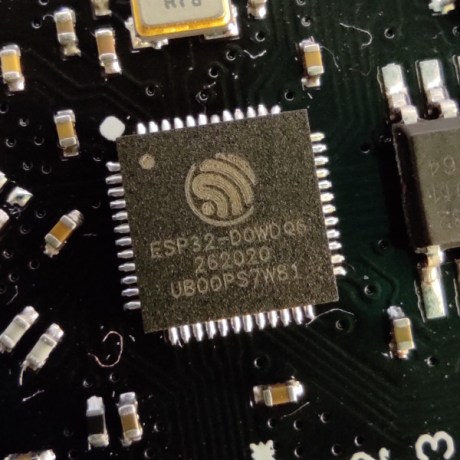
Discovering SDRs EverywhereBy Elliot Williams To quote commenter [douyarou], “It’s like our little version of a Precambrian explosion”. A bunch of hackers have discovered, independently and building on each other’s work, software-defined radio (SDR) capabilities in more places than you can shake a stick at. It all started with [Espargos] and [h0m3us3r] apparently independently discovering that the ESP32 family of chips had a “secret” debug mode that allowed direct access to the radio that’s normally used for WiFi. While the 2.4 GHz radio signal is almost always immediately converted into data by the MAC hardware, here they found a way to listen in upstream, to the raw IQ streams. Seeing this, folks were immediately inspired to find out if they could transmit as well. [marble] not only got transmit functionality working, but integrated the part in with the standard osmosdr data flow, which meant that a whole bunch of existing tools were ready to go. We didn’t know about it at the time, but apparently [jochenhammes] and [z1000biker] concurrently had their TX-capable hacks up and running: here and here. At this point, folks have already started to use the capabilities for broadcasting digital TV signals, voice signals, FM Hell, and other hijinks. This reminds us of the early days of the RTL-SDR project, when a competent, if receive-only, SDR functionality was found in a bunch of USB TV-tuner dongles. Once the hardware capabilities were sussed out, people started writing all sorts of useful software, and it gave rise to all manner of radio projects, from simply poking at domestic wireless devices to tracking all the airplanes in the world as they fly by. [Tom] and I were discussing this on the podcast, and he remarked that of course there are SDRs hidden everywhere there is a radio unit these days, and the question is just whether or not we could hack them into usability. And before the podcast was even finally edited, [Samson1te] told us about his find in the LR2021 LoRa chip. This is a radio that’s designed to be a radio, with 16-bit resolution, and covering lower frequencies from 150 MHz to 960 MHz. Compared to the RTL-SDR revolution, this is all happening at incredible speed. Each of these hacks will enable us to use different slices of radio spectrum with different degrees of ease, but it’s clear that the cost of entry into playing around with digital radio has just dropped precipitously. We will see hundreds of new signals hacks in the next few months – the floodgates have been opened. |









Комментарии
Отправить комментарий